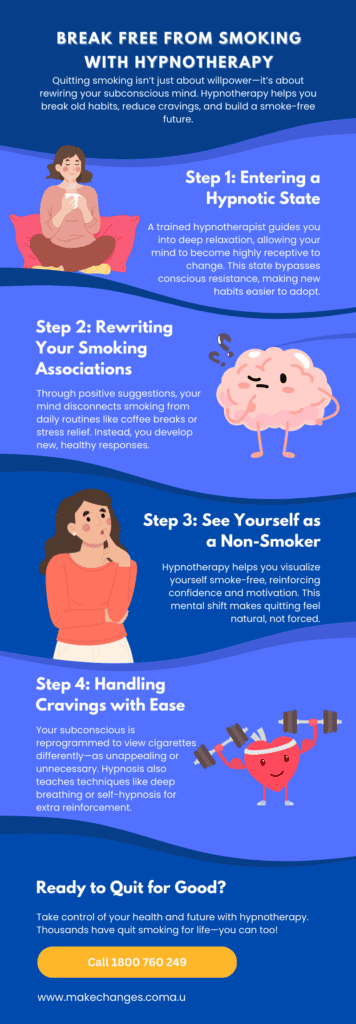

Hypnotherapy can offer a clear path to quit smoking by helping change the subconscious habits tied to nicotine addiction.

Estimated reading time: 15 minutes.
- Understand how nicotine creates both physical and psychological dependencies
- Learn how hypnotherapy accesses your subconscious to reframe smoking behaviors
- Discover effective NLP techniques that complement hypnotherapy
- Follow a proven step-by-step plan to quit smoking for good. For more detailed guidance, check out our Quit Smoking Service to support your journey.
- Gain insights from real success stories and practical techniques
- Understanding Nicotine Addiction
- The Dangers and Risks of Long-Term Smoking Habits
- How Hypnotherapy to Quit Smoking Works
- Combining NLP Smoking Cessation Strategies with Hypnotherapy
- Important Behavioral Strategies to Quit Smoking
- A Step-by-Step Quit Smoking Plan
- Step 1: Preparation and Commitment (1-2 Weeks Before Quit Date)
- Step 2: The Hypnotherapy Foundation (1-3 Sessions)
- Step 3: Implementation of NLP Techniques (First Week After Quitting)
- Step 4: Daily Tracking and Reinforcement (Ongoing)
- Step 5: Lifestyle Integration (Weeks 2-4)
- Step 6: Maintaining Motivation and Accountability (Ongoing)
- Real-Life Quit Smoking Hypnosis Success
- Maintaining a Smoke-Free Life with NLP Techniques
- Understanding the Total Cost of Smoking Habit
- Cost of Smoking Abroad & Fines
- Conclusion
- Call to Action
Understanding Nicotine Addiction
Nicotine addiction represents one of the most complex dependencies to overcome, characterized by its dual nature as both a physical and psychological challenge. When you smoke, nicotine triggers the release of dopamine in the brain, creating pleasurable sensations that become linked with the act of smoking itself.
According to research, “Nicotine addiction has both psychological and physical components,” making it particularly difficult to address with single-approach methods. This dual nature explains why many smokers struggle to quit despite genuine desire and multiple attempts.
The psychological component of nicotine addiction manifests in several ways:
- Habitual triggers – Everyday activities become strongly associated with smoking (morning coffee, driving, after meals)
- Stress response – Many smokers rely on cigarettes as their primary coping mechanism for anxiety or tension
- Social connections – Smoking often becomes deeply embedded in social routines and relationships
- Identity connection – Long-term smokers may incorporate smoking into their self-image
The physical dependency adds another layer of difficulty, with withdrawal symptoms including irritability, anxiety, increased appetite, and intense cravings. These physical responses can last for weeks, challenging even the most determined quitters.
This complex interplay between mind and body explains why comprehensive approaches like hypnotherapy and NLP have gained traction. Unlike methods that address only physical dependence, these techniques target the deep psychological associations that maintain the smoking habit, working at the subconscious level where many of these connections are formed and maintained.
Understanding that smoking is not simply a “bad habit” but a multifaceted addiction helps explain why willpower alone is rarely sufficient, and why techniques that address both the conscious and subconscious aspects of addiction show greater promise for long-term success. For further understanding of quitting methods, you can read our article on how quitting smoking can transform your life.
The Dangers and Risks of Long-Term Smoking Habits
The risks of long-term smoking habits extend far beyond the occasional cough or shortness of breath. As cigarette smoke contains over 7,000 chemicals, including at least 70 known carcinogens, the damage accumulates silently throughout the body for years before manifesting as serious, often life-threatening conditions.
Research has conclusively demonstrated that “Smokers lose an average of 10 years of life expectancy compared to non-smokers,” a sobering statistic that highlights the cumulative impact of this habit. This decade of life lost represents countless missed moments with loved ones and unfulfilled personal aspirations.
The major health risks associated with continued smoking include:
- Respiratory diseases – COPD, emphysema, chronic bronchitis, and frequent respiratory infections
- Cardiovascular damage – Coronary heart disease, stroke, damaged blood vessels, and high blood pressure
- Cancer development – Not just lung cancer, but increased risks of throat, mouth, esophagus, bladder, and pancreatic cancers
- Reproductive issues – Reduced fertility, complications during pregnancy, and early menopause
- Compromised immunity – Weakened immune system and slower healing from injuries and surgeries
Beyond these direct health impacts, smoking affects nearly every aspect of daily life. Smokers typically experience diminished sense of taste and smell, premature skin aging, stained teeth, and persistent bad breath. The habit also restricts activities through reduced stamina and breathing capacity, limiting participation in physical activities that contribute to overall health and well-being.
Understanding these serious risks provides important motivation for seeking effective cessation methods. When conventional approaches fail, alternatives like hypnotherapy for quitting smoking become increasingly valuable. These techniques can help address the psychological barriers that prevent many smokers from successfully quitting despite full awareness of these health consequences.
The urgency of finding effective cessation strategies cannot be overstated – research shows that quitting smoking, even after many years, can substantially reverse risks and add years back to life expectancy. This makes exploring all available options, including hypnotherapy and NLP, a potentially life-saving decision.
How Hypnotherapy to Quit Smoking Works
Hypnotherapy to quit smoking works by creating a direct channel to the subconscious mind, where many smoking behaviors and associations are deeply rooted. Unlike conscious decision-making approaches that rely solely on willpower, hypnotherapy addresses the automatic, habitual aspects of smoking that often sabotage quit attempts.
During a hypnotherapy session, you enter a state of focused relaxation and heightened suggestibility. This state allows the therapist to communicate directly with your subconscious mind, where they can help reframe your relationship with cigarettes. Research confirms that “Hypnotherapy can reframe smoking behaviors,” allowing longtime smokers to develop new mental patterns around situations that previously triggered smoking urges. [source]
A typical hypnotherapy session for smoking cessation includes several key components:
- Deep relaxation induction – Guiding you into a receptive, focused mental state
- Positive suggestion work – Introducing new associations with health, freedom, and clean air
- Visualization techniques – Creating mental images of yourself as a non-smoker
- Aversion therapy elements – Sometimes including suggestions that cigarettes taste unpleasant
- Future-self programming – Mentally rehearsing success as a non-smoker in challenging situations
The benefits of hypnotherapy for smoking cessation are numerous:
- It addresses unconscious motivations and habits that willpower alone cannot overcome
- Sessions can reduce physical cravings by altering how your brain processes nicotine urges
- The technique can help dismantle psychological ties between smoking and specific triggers
- Hypnotherapy creates positive associations with being smoke-free rather than feelings of deprivation
- Multiple sessions build lasting changes in both thought patterns and behaviors
Many people find that hypnotherapy helps them quit with fewer withdrawal symptoms than expected. This occurs because a significant portion of withdrawal discomfort stems from psychological expectations rather than just physical dependency. When these expectations are reframed through hypnosis, the process becomes noticeably easier.
Importantly, hypnotherapy for smoking cessation isn’t about mind control or having someone else take over your will. Instead, it’s a collaborative process that helps align your conscious desire to quit with unconscious patterns that may be maintaining the habit. This alignment creates powerful internal congruence that supports lasting change.
Combining NLP Smoking Cessation Strategies with Hypnotherapy
NLP smoking cessation strategies provide powerful complementary techniques that enhance the effectiveness of hypnotherapy, creating a comprehensive approach to breaking nicotine addiction. Neuro-Linguistic Programming (NLP) focuses on the connection between neurological processes, language, and behavioral patterns developed through experience.
When combined with hypnotherapy, NLP creates a multi-dimensional approach to overcome nicotine addiction with hypnosis by targeting both the subconscious programming and the conscious language patterns that maintain smoking behavior. This integration addresses the complex nature of smoking addiction more thoroughly than either technique alone.
The most effective NLP techniques for smoking cessation include:
- Pattern interruption – Breaking habitual sequences that lead to smoking
- Anchoring – Creating positive emotional states that can be triggered when cravings appear
- Submodality shifts – Changing how smoking is represented in your mind (making cigarette imagery less appealing)
- Reframing – Altering how your mind interprets smoking triggers and urges
- Future pacing – Mentally rehearsing successfully navigating high-risk situations as a non-smoker
For example, a powerful NLP anchoring technique works by having you recall a time when you felt completely in control and confident. While fully experiencing this state, you create a physical anchor (perhaps pressing thumb and finger together) that you can later activate when facing a smoking urge, instantly accessing those feelings of control.
The complementary nature of these approaches is significant because:
- Hypnotherapy creates deep subconscious receptivity to change
- NLP provides specific linguistic and behavioral tools to implement that change
- Together they address both automatic habits and conscious decision-making
- The combination creates multiple pathways to reinforce your non-smoking identity
Many practitioners integrate these techniques seamlessly in their sessions. For instance, during hypnotic trance, an NLP reframing technique might be introduced to transform how your mind perceives cigarettes – shifting them from objects of desire to symbols of control loss or health deterioration.
The synergy between hypnotherapy and NLP smoking cessation strategies creates a robust framework for quitting. While hypnotherapy helps dismantle old programming, NLP equips you with active tools to manage triggers and cravings in real-world situations. This comprehensive approach addresses both the historical patterns that established the addiction and the present-moment challenges of maintaining a smoke-free life.
Important Behavioral Strategies to Quit Smoking
Successful smoking cessation requires a multi-faceted approach that extends beyond mental techniques. Behavioral strategies to quit smoking create the necessary environmental and habitual changes that support your journey to becoming smoke-free. When combined with hypnotherapy and NLP techniques, these practical strategies dramatically improve your chances of long-term success.
Understanding your personal smoking patterns is the foundation of effective behavioral change. Most smokers have established deeply ingrained routines around when, where, and why they smoke. Identifying these patterns allows you to proactively address them rather than relying solely on willpower in the moment.
Essential behavioral strategies include:
- Trigger identification and management – Recognizing situations, emotions, or activities that prompt smoking urges
- Environment modification – Removing ashtrays, lighters, and other smoking-related items from your space
- Routine disruption – Changing daily sequences that incorporate smoking (taking a different route to work, rearranging morning routines)
- Substitution planning – Preparing healthy alternatives for moments when cravings strike
- Social strategy development – Creating plans for navigating social situations where smoking was previously central
Implementing these strategies requires thoughtful preparation. For example, if you typically smoke during work breaks, develop a specific alternative activity for these times—perhaps a short walk, breathing exercises, or connecting with a supportive colleague. Having this plan in place before quitting prevents being caught unprepared when habitual triggers arise.
Physical activity deserves special attention as a behavioral strategy. Exercise not only distracts from cravings but also:
- Reduces stress and anxiety that often trigger smoking urges
- Releases endorphins that improve mood and counteract withdrawal symptoms
- Helps prevent weight gain that sometimes accompanies quitting
- Provides measurable improvements in health that reinforce your decision to quit
Creating a supportive environment extends to your social circles as well. Research shows that social support significantly increases quitting success rates. Consider:
- Informing friends and family about your quit plan and requesting specific support
- Temporarily limiting time spent with people who smoke, if possible
- Joining a support group (online or in-person) for accountability and encouragement
- Finding a “quit buddy” who is also trying to stop smoking or has successfully quit
When these behavioral strategies to quit smoking are integrated with the psychological approaches of hypnotherapy and NLP, you create a comprehensive cessation system. The behavioral techniques support what’s happening at the subconscious level through hypnotherapy, while the NLP tools help you mentally navigate challenging situations that your behavioral strategies can’t completely eliminate.
This holistic approach recognizes that smoking addiction exists in multiple dimensions—psychological, physical, behavioral, and social—and addresses each area with appropriate techniques for lasting freedom from nicotine.
A Step-by-Step Quit Smoking Plan
A well-structured step-by-step quit smoking plan provides the roadmap necessary for successfully transitioning to a smoke-free life. By breaking down this significant change into manageable steps and combining hypnotherapy with practical actions, you can navigate the quitting process with greater confidence and higher chances of lasting success.
Step 1: Preparation and Commitment (1-2 Weeks Before Quit Date)
Begin by setting a specific, meaningful quit date—perhaps a birthday, anniversary, or the start of a new month. This concrete timeline helps solidify your commitment while giving you time to properly prepare. During this period:
- Research and schedule your first hypnotherapy session
- Begin keeping a smoking journal to identify your triggers and patterns
- Inform supportive friends and family about your plan
- Gather resources (apps, books, supportive communities)
- Consider gradually reducing cigarette consumption if appropriate for you
Step 2: The Hypnotherapy Foundation (1-3 Sessions)
Schedule your initial hypnotherapy sessions to strategically align with your quit date—ideally having the first session shortly before quitting and follow-up sessions in the early weeks. During these sessions:
- Work with your hypnotherapist to address specific psychological aspects of your smoking habit
- Learn self-hypnosis techniques to use between sessions
- Develop personalized mental imagery for managing cravings
- Begin reframing your identity from “smoker trying to quit” to “non-smoker”
Step 3: Implementation of NLP Techniques (First Week After Quitting)
As you begin your smoke-free journey, actively apply NLP techniques learned during hypnotherapy or through additional resources:
- Practice pattern interruption whenever familiar smoking urges arise
- Use anchoring techniques to access calm and control during challenging moments
- Implement visualization exercises multiple times daily
- Apply reframing language to internal dialogue about smoking and cravings
Step 4: Daily Tracking and Reinforcement (Ongoing)
Maintain momentum through conscious tracking and positive reinforcement:
- Use a dedicated app or journal to record smoke-free days
- Document cravings, triggers, and successful coping strategies
- Celebrate milestones (24 hours, 1 week, 1 month) with meaningful rewards
- Listen to reinforcement hypnosis recordings regularly
- Track health improvements and financial savings as they accumulate
Step 5: Lifestyle Integration (Weeks 2-4)
Begin integrating new healthy habits to replace smoking routines:
- Establish consistent exercise patterns, even if just brief daily walks
- Develop new relaxation techniques (deep breathing, mindfulness)
- Create new post-meal rituals to replace smoking
- Find smoke-free ways to take breaks during work
Step 6: Maintaining Motivation and Accountability (Ongoing)
Establish systems to maintain motivation through challenging periods:
- Join support communities (online forums, local groups)
- Schedule regular check-ins with an accountability partner
- Plan follow-up hypnotherapy sessions at strategic intervals (1 month, 3 months)
- Create visual reminders of your reasons for quitting in key locations
This step-by-step quit smoking plan integrates multiple approaches for comprehensive support. The hypnotherapy sessions work at the subconscious level while daily practices reinforce these changes consciously. The regular tracking and accountability elements help bridge potential weak points in the process.
Remember that this plan should be personalized to your specific needs and circumstances. Some people may benefit from more frequent hypnotherapy sessions initially, while others might place greater emphasis on physical activity or social support aspects. The key is maintaining the integrated approach that addresses both the psychological and practical aspects of quitting smoking.
Real-Life Quit Smoking Hypnosis Success
Hypnotherapy has helped countless individuals break free from smoking, even after years of failed attempts with other methods. The following real testimonials from people who worked with Wendy showcase how effective hypnosis can be in overcoming nicotine addiction.
Elizabeth’s Story
“Wendy, you are a miracle worker! I was a smoker for 24 years (more than half my life). One session with Wendy and I have not had a cigarette. I can’t believe doctors recommend smoking aids and pills rather than hypnotherapy!” – Elizabeth S. via Google
Dean’s Experience
“It’s 7 weeks today—it’s like a minor miracle to be honest. I don’t know how hypnotism works, but it just does. Cigarettes hold no appeal to me—they are just nothing. Oh, and I spent years working for a tobacco company. At my worst, I hit 80 cigarettes a day. If this worked for me, Wendy can make it work for you.” – Dean Flemington via Womo
Rosa’s Transformation
“If I could give Wendy a 100-star review, I would. Wendy has changed my life. Thanks to her, I have been smoke-free for six months! I honestly walked into the clinic a total cynic and came out a believer.” – Rosa S. via Womo
Andrew’s Continued Success
“The ongoing support has encouraged me to continue being a non-smoker—day 101 today. Thank you, Wendy! Highly recommended.” – Andrew Law via Google
Domenic’s Journey to a Smoke-Free Life
“Well, it’s been 12 months since having my last smoke. Thank you, Wendy, as I thought for sure I would never quit. Going from 30 smokes a day to none, without any tablets, inhalers, or other aids, has been unbelievable.” – Domenic Cugliari via Google
Many smokers who have struggled for years find that hypnotherapy provides an entirely different experience—one that doesn’t rely on willpower alone. The shift happens on a subconscious level, reducing cravings and changing the way the mind perceives smoking.
For some, quitting with hypnotherapy feels effortless, while others may need additional reinforcement sessions or complementary techniques like NLP. However, the common thread among these success stories is the lasting impact—hypnosis helped them quit for good. If you’ve tried to stop smoking before and nothing has worked, these testimonials prove that hypnotherapy could be the breakthrough you’ve been looking for.”
Several common elements appear in successful hypnotherapy cases like Sarah’s:
- Complete commitment to the process, approaching sessions with openness
- Professional guidance from experienced hypnotherapists specialized in addiction
- Complementary techniques like NLP to reinforce hypnotic suggestions
- Follow-up sessions to address any emerging challenges
- Self-hypnosis practice between professional sessions
Research supports these anecdotal successes. A meta-analysis published in the Journal of Applied Psychology found that hypnotherapy participants were more likely to be abstinent at 6 months compared to those who received no treatment. When combined with other methods, success rates improved even further.
Maintaining a Smoke-Free Life with NLP Techniques
Sustaining your non-smoking status long-term requires effective mental strategies that prevent relapse during challenging situations. Smoke-free life NLP techniques provide powerful tools for rewiring thought patterns and maintaining your commitment when faced with triggers or stress that might otherwise lead to resuming the smoking habit.
The most effective NLP techniques for maintaining a smoke-free lifestyle focus on creating new neural pathways and responses to situations previously associated with smoking. By consistently practicing these methods, you strengthen your identity as a non-smoker while weakening old associations with cigarettes.
Visualization Technique: Future Success Projection
This powerful NLP exercise strengthens your commitment by vividly experiencing the benefits of remaining smoke-free:
- Find a quiet space and close your eyes
- Imagine yourself 6 months, 1 year, and 5 years in the future as a non-smoker
- Make the images vibrant and detailed—notice your improved skin, easier breathing, confidence
- Imagine successfully handling challenging situations without cigarettes
- Experience the pride and freedom of long-term success
- Practice this visualization daily for 5 minutes, especially when motivation wavers
Internal Dialogue Reframing
How you talk to yourself about smoking significantly impacts your success. Transform destructive internal language with this technique:
- Identify negative self-talk patterns (“This is too hard,” “I need a cigarette to relax”)
- Create powerful alternative statements (“I’m growing stronger every day,” “I relax naturally without cigarettes”)
- Immediately replace negative thoughts with these empowering alternatives
- Speak these affirmations aloud when possible for stronger impact
- Repeat consistently until new thought patterns become automatic
The “Swish” Pattern for Craving Management
This classic NLP technique helps replace unwanted urges with positive alternatives:
- When a craving begins, identify the mental image that represents smoking
- Create a compelling image of yourself as a confident non-smoker, enjoying the benefits of being smoke-free
- Make the smoking image smaller and dimmer while making the non-smoking image larger and brighter
- Mental “swish” the first image away, rapidly replacing it with the positive image
- Accompany this with a “whoosh” sound in your mind
- Repeat 5-7 times whenever cravings emerge
Anchor Installation for Emotional Regulation
Create a portable resource state to access calm and control in triggering situations:
- Recall a time when you felt completely in control, confident, and at peace
- As you fully experience these feelings, press your thumb and middle finger together (or choose another discrete physical gesture)
- Hold for 5-10 seconds while intensifying the positive feelings
- Release and repeat 5 times, each time strengthening the association
- Practice regularly to strengthen this “anchor”
- When facing a situation where you might have smoked, use this anchor to instantly access your resource state
These smoke-free life NLP techniques work by creating new neural pathways that bypass old smoking triggers. Through consistent practice, you essentially rewire your brain’s automatic responses, transforming previously challenging situations into opportunities to reinforce your non-smoking identity.
What makes these techniques particularly effective is their portability and discretion—you can use them anywhere without others noticing. They provide immediate support in real-world situations where traditional cessation methods might fall short.
For maximum effectiveness, practice these NLP techniques regularly, not just when facing cravings. This proactive approach strengthens your non-smoker identity and makes the techniques more available and powerful when you genuinely need them.
Understanding the Total Cost of Smoking Habit
The total cost of smoking habit extends far beyond the price of cigarettes, creating financial burdens that many smokers fail to fully recognize until they quit. Understanding these comprehensive costs provides powerful additional motivation for maintaining a smoke-free lifestyle, complementing the health benefits and personal freedom gained through hypnotherapy and NLP techniques. Learn more about the financial reasons to quit smoking.
Direct Financial Costs
The most obvious expense is the cigarettes themselves, which create a substantial financial drain:
- A pack-a-day smoker in the United States spends approximately $2,300 to $5,000 annually on cigarettes alone, depending on state taxes
- Over 10 years, this represents $23,000 to $50,000 in direct costs
- Over a 40-year smoking period, the lifetime expenditure ranges from $92,000 to $200,000
- These figures rise annually as tobacco taxes increase in most regions
However, cigarette purchases represent only the beginning of the financial impact:
- Smokers face higher premiums for health, life, and home insurance
- Dental costs increase due to staining, gum disease, and other smoking-related oral health issues
- Cleaning costs rise for homes, vehicles, and clothing
- The resale value of cars and homes decreases significantly when owned by smokers
Hidden Economic Impacts
Less visible but equally significant are the economic opportunity costs:
- Smokers take more sick days, averaging 2-3 additional days off work annually
- Lost productivity due to smoke breaks represents approximately 1 hour per workday (250+ hours yearly)
- Career advancement may be limited, as studies show smokers earn 4-11% less than non-smokers with similar qualifications
- Investment opportunity loss—if the money spent on cigarettes were invested instead, it would generate substantial returns over time
To illustrate this point, consider that $2,300 invested annually with a modest 6% return would grow to over $250,000 after 40 years—a significant retirement fund created solely from redirected smoking expenditures.
Healthcare Burden
The longest-term financial impact comes from increased healthcare costs:
- Out-of-pocket expenses for treating smoking-related illnesses
- Higher co-pays and deductibles due to more frequent medical visits
- Prescription costs for conditions caused or worsened by smoking
- Potential long-term care expenses from debilitating conditions like COPD or stroke
- Lost income during extended illnesses or reduced working capacity
Financial Benefits of Quitting
Understanding the total cost of smoking habit provides clarity about the significant financial gains of quitting:
- Immediate daily savings from cigarette purchases
- Reduced cleaning and maintenance costs
- Gradually decreasing insurance premiums
- Fewer medical expenses and co-pays
- Improved workplace productivity and earning potential
Many former smokers report that the financial benefits become increasingly motivating as they progress in their smoke-free journey. What begins as a health-focused decision evolves into a financially rewarding lifestyle change that funds other life goals and experiences.
For those using hypnotherapy to quit smoking, incorporating these financial realities into hypnotic suggestions can strengthen motivation. Visualizing specific financial goals achieved through redirected smoking expenditures creates powerful incentives that complement health-focused reasons for maintaining a smoke-free life.
Cost of Smoking Abroad & Fines
The cost of smoking abroad and fines represent additional financial considerations that many smokers overlook when calculating the true expense of their habit. International travel presents smokers with a complex landscape of varying regulations, prices, and penalties that can significantly impact both vacation budgets and travel experiences.
Cigarette prices vary dramatically across countries, with some nations imposing substantially higher taxes than others:
- Australia leads with prices exceeding $25 USD per pack, making a week-long trip potentially cost an additional $175+ for a pack-a-day smoker
- United Kingdom and Ireland follow closely with prices around $14-15 USD per pack
- New Zealand, Norway, and Iceland all maintain prices above $12 USD per pack
- Japan, Singapore, and parts of Eastern Europe offer significantly lower prices but have increasingly strict regulations about where smoking is permitted
These price variations create unexpected budget pressures for traveling smokers. A two-week European vacation could add hundreds of dollars in unanticipated expenses simply to maintain a smoking habit, funds that could otherwise enhance the travel experience through additional activities or accommodations.
Beyond purchase costs, smoking abroad increasingly involves navigating complex regulatory environments:
- Public smoking bans exist in most developed countries, with varying degrees of enforcement
- Outdoor smoking restrictions continue to expand in tourist areas, beaches, and restaurant terraces
- Hotel policies increasingly designate all rooms as non-smoking, with substantial cleaning fees (often $200-500) for violations
- Rental car companies typically charge cleaning fees of $250+ if smoking evidence is detected
The fines for violating smoking regulations can be particularly severe in certain regions:
- Singapore enforces strict anti-smoking laws with fines up to $1,000 SGD ($740 USD) for first offenses
- Thailand has beach smoking bans with penalties up to 100,000 baht ($3,000 USD)
- Hong Kong issues fixed penalty notices of 1,500 HKD ($190 USD) for smoking in prohibited areas
- Italy, Spain, and Greece have fines ranging from €30-600 ($35-700 USD) depending on the location of the violation
- Japan has recently strengthened enforcement with fines up to ¥50,000 ($450 USD) in certain cities
These penalties are not merely theoretical—many tourists report being fined for smoking in restricted areas, creating stressful situations in unfamiliar legal systems and languages. Even in countries with moderate financial penalties, being cited for smoking violations creates unnecessary travel complications and stress.
Additionally, smoking abroad creates logistical challenges:
- Finding designated smoking areas in unfamiliar cities
- Airport layovers in airports with limited or distant smoking areas
- Time constraints when needing to exit secure areas or buildings to smoke
- Weather issues when forced to smoke outdoors in uncomfortable conditions
For those using hypnotherapy to quit smoking, these international considerations provide additional motivation. Visualizing stress-free travel without the need to locate smoking areas or worry about inadvertently violating local regulations can be a powerful component of hypnotic suggestion work.
Understanding the cost of smoking abroad and fines provides a compelling practical reason to quit before traveling, complementing the health and general financial benefits. A smoke-free international trip offers greater freedom, reduced stress, and more available funds to enjoy the destination—powerful incentives for making a permanent change.
Conclusion
Hypnotherapy to quit smoking represents a powerful and increasingly recognized approach to breaking free from nicotine addiction. Throughout this guide, we’ve explored how this technique, especially when combined with NLP strategies, addresses the complex psychological foundations of smoking addiction that many conventional methods overlook.
The effectiveness of hypnotherapy for smoking cessation stems from its ability to access the subconscious mind—the place where smoking habits and associations are deeply rooted. By working at this level, hypnotherapy can help reframe how you think about cigarettes, transform trigger responses, and establish new patterns of behavior that support a smoke-free lifestyle.
We’ve examined how complementary NLP techniques enhance hypnotherapy by providing specific mental tools to manage cravings and challenging situations. These include visualization exercises, anchoring techniques, and powerful reframing strategies that help maintain your commitment when faced with triggers that previously led to smoking.
The comprehensive approach outlined in this guide addresses all dimensions of smoking addiction:
- The psychological patterns that hypnotherapy directly targets
- The behavioral habits that can be transformed through practical strategies
- The financial burden that provides additional motivation for quitting
- The social and travel-related challenges that smoking creates
Perhaps most importantly, we’ve seen through real-life success stories that this approach can succeed where other methods have failed. The combination of professional hypnotherapy sessions with consistent application of NLP techniques creates a powerful framework for not just quitting smoking, but becoming someone who genuinely no longer desires cigarettes.
The financial benefits of quitting are substantial, with the average smoker saving thousands of dollars annually—funds that can be redirected toward meaningful life goals and experiences. Add to this the documented health improvements, from better respiratory function to reduced cancer risk, and the case for quitting becomes overwhelming.
For those who have attempted to quit multiple times using willpower or nicotine replacement therapies, hypnotherapy offers a distinctly different approach that may provide the breakthrough needed. Rather than fighting cravings through constant conscious effort, hypnotherapy aims to diminish or eliminate those cravings at their source.
Call to Action
If you’re serious about breaking free from smoking and reclaiming your health, finances, and freedom, consider exploring hypnotherapy as your path forward. Here are specific steps you can take today:
- Research qualified hypnotherapists in your area who specialize in smoking cessation
- Schedule a consultation to discuss your specific smoking patterns and history
- Commit to the full process, typically involving 2-3 sessions for maximum effectiveness
- Combine approaches by implementing the behavioral strategies and NLP techniques outlined in this guide
- Track your progress using a journal or app to document improvements and challenges
Have you tried hypnotherapy to quit smoking or are you considering it? Share your experiences or questions in the comments section below. Your story might inspire others to take this important step toward improved health and freedom from nicotine.
Remember that building a community of support enhances your chances of success. Connect with others on similar journeys, whether through local support groups or online forums dedicated to smoking cessation through hypnotherapy.
If you found this guide helpful, please share it with friends or family members who might benefit from learning about this powerful approach to quitting smoking. Together, we can spread awareness about effective alternatives to conventional cessation methods and help more people break free from nicotine addiction permanently.